
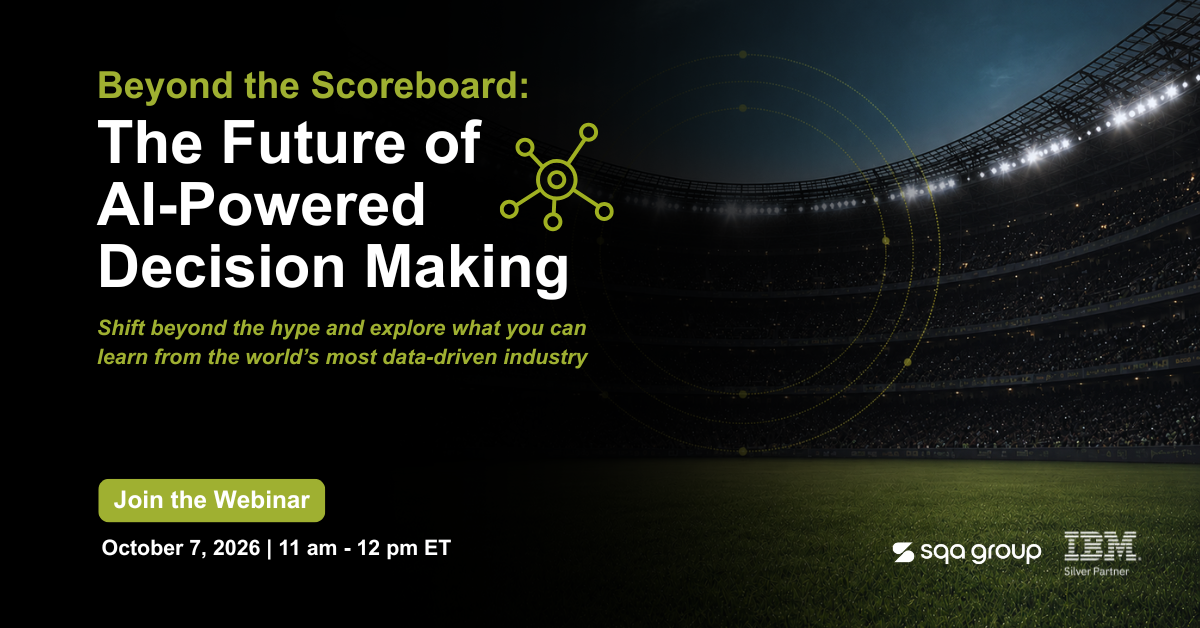

*IBM and SQA Group are partnering on October 7, 2026, for a webinar, “Beyond the Scoreboard: The Future of AI-Powered Decision Making.” Matt D’Andraia will join SQA Group’s Chief Data & Technology Officer David Pacific for a behind-the-scenes look at how AI is changing the game and what business leaders can learn from it; join us!
I spend a lot of my time thinking about sports, data and AI, which, in my world, is a pretty fun combination. I’m lucky to spend my days witnessing firsthand how organizations across the sports industry are using AI to create better experiences for fans, athletes, teams and businesses.
From the US Open and Wimbledon to the UFC, The Masters and ESPN Fantasy Football, the use cases are incredibly varied. But the more I work in this space, the more I believe the most interesting part of AI isn’t the technology itself. It’s what happens when you take an enormous amount of data and make it easier for people to understand and act on.
Consider a tennis match. Every point generates data: serve speed, first-serve percentage, break points, rally length, player rankings, historical performance and countless other signals.
We could put all that information in front of a fan and call it an analytics experience. But most fans aren’t looking for a spreadsheet. They want to understand the story unfolding in front of them:
- Why did the momentum change?
- Who has the advantage?
- What should I be watching next?
That distinction between data and understanding is becoming increasingly important as AI makes it possible to work with more information than ever before.
The Enterprise Has the Same Problem
Inside a business, the data challenge looks different, but the underlying problem is remarkably similar.
Organizations have invested heavily in dashboards, reports, data warehouses, analytics platforms and AI. Yet getting from “Here’s the data” to “Here’s what it means, and here’s what we should do about it” can still require an enormous amount of human interpretation.
A business leader shouldn’t have to understand how a data model was built to answer a question about performance. A marketing leader shouldn’t have to pull information from five reports to understand why a campaign is underperforming. And a sales leader shouldn’t have to become a data analyst to determine where an opportunity is emerging.
Yet that is still how many decisions are being made. We open a dashboard, find the right report, apply filters, compare numbers, and then we spend time figuring out what they actually mean.
We’ve spent years making data more accessible, but we haven’t always made it easier to understand. This is where AI creates a real opportunity to change the way organizations work.
What Sports Can Teach Us About Enterprise AI
At IBM — a trusted partner of SQA Group — we believe that sports gives us a highly visible proving ground to demonstrate how technology performs at scale, in real time, and in moments where failure is not an option.
Through partnerships with organizations like the US Open, Wimbledon, The Masters and UFC, millions of fans experience IBM technology directly. The US Open alone reaches more than 14 million digital users. These environments give us an opportunity to demonstrate that the same AI, data, automation and hybrid cloud capabilities supporting some of the world’s biggest sporting events can also be applied to some of the most critical challenges facing businesses.
That’s what makes sports such an interesting lens for looking at enterprise AI.
At the US Open, for example, IBM and the USTA are using AI to transform large volumes of match data into more intuitive experiences for fans. AI-powered Key Moments can identify turning points that change the momentum of a match, while Match Chat allows fans to ask questions in natural language and receive answers grounded in live and historical match data.
The important part isn’t simply that AI can process all of that information. It’s that the technology can translate complexity into something meaningful to the person experiencing it. A fan doesn’t need to know how the underlying model works to understand why a match is shifting.
That same principle applies inside a business. Employees shouldn’t need to understand the architecture behind a data platform to answer a business question. The technology should do more of that work for them.
From Information to Intelligence
This is one of the reasons I’m excited about the work we’re doing with SQA Group; dive deeper here. We keep coming back to the idea that data must be humanized, making analytics and AI work more like the way people naturally think, ask questions and make decisions.
The technology may be complex, but the experience shouldn’t be. Whether you’re trying to understand a shift in momentum during a tennis match or figure out why a business metric changed, the question is often the same: “So what does this mean for me?”
I believe the organizations that get the most value from AI will be the ones that can answer that question clearly putting the right information in the right context and making it easier for people to act.
Sports makes this visible. Fans don’t need every data point; they need the insight that helps them understand the moment. Businesses aren’t that different. We don’t need more dashboards. We need better ways to turn data into understanding, and understanding into decisions.
The score tells you what happened. The data helps explain why. AI can help you understand what happens next.
If you’re interested in what this looks like in practice, and what lessons sports can teach us about making AI and analytics more human, I’d love to continue the conversation. Join me at our October 7, 2026, webinar with SQA Group, where we’ll explore how organizations can move beyond simply reporting on data to creating AI-powered experiences that help people understand it, trust it and act on it. Grab your spot and learn more here.